

A Brief Introduction to Hindu Tantra
Table of Contents
In the decade of the 1960s, during the first “Summer of Love”, ancient knowledge about spiritual energies and body techniques of meditation, which date back to the IVth century C.E., was gradually carried from Eastern to Western societies, especially those that originated in India, like Yoga and Tantra. Following the rail of sexual liberation and a thirst for spiritual unity, Tantra arrived to shake Western tradition around spirituality, intimacy, and sexuality.
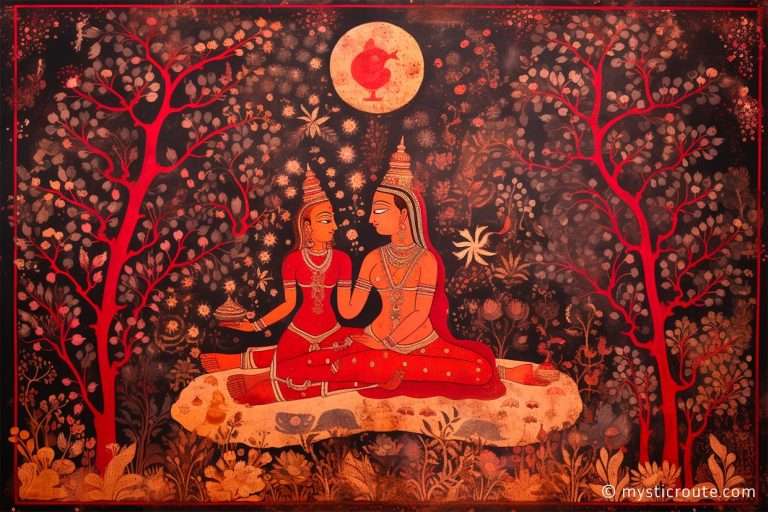
Developed in ancient India, Hindu Tantra is a spiritual philosophy that centers on the cosmic principles of Shiva and Shakti, the masculine and feminine energies whose sacred union gives rise to the universe itself. According to Tantra, Shiva represents pure consciousness, while Shakti is the energetic power that animates all creation. All of existence arises from the joyous intercourse of Shiva and Shakti, pulsating with divine energy in an endless cosmic dance.
Through Tantra, we can see the universe itself as the material embodiment of Shiva-Shakti. All things, including the human body, are infused with potency. Unlike philosophies that spurn the physical world as an illusion, Tantra embraces life and sensuality as pathways to spirit. By understanding the workings of Shiva-Shakti throughout the cosmos, in the human body, and in the ritual life, Tantra offers a profoundly practical path to enlightenment in which all aspects of living can become sacred. One can activate spiritual energy, awaken consciousness, balance masculine and feminine forces inside, and finally realize one’s identity with the pleasure of Shiva-Shakti union through a variety of practices. For some Tantrics, sacred sexuality, or maithuna, serves as a ritual metaphor for divine connection.
The concept that Shiva and Shakti, consciousness and energy, pervade all things in creative polarity is central to Tantric philosophy. Understanding their manifestations throughout existence and devoted practice of Tantric techniques may release spiritual potencies within to realize the transcendent through the material, reach wisdom and bliss in one’s own body, and know oneself as a living conduit for Shiva-Shakti’s creative play. This is the promise and goal at the heart of Tantra’s acceptance of life as a spiritual path: to awaken as an incarnation of the ecstatic union that creates and sustains all reality.
Though its sacred texts provide philosophical grounding, the Tantra places utmost importance on spiritual practice. Tantrics practice specific ritual forms of mantra, mudra, puja, meditation, and yoga to accelerate the unfoldment of hidden spiritual faculties, activate consciousness throughout the subtle body, balance and awaken cosmic masculine and feminine energies, raise kundalini through the chakras, and eventually attain enlightenment. This implies that the ego, or limited sense of self, is transcended in the realization of identity with Shiva-Shakti, a state of unity beyond duality or division. According to Hindu Tantra, the purpose of spiritual life is to awaken spontaneous nondual understanding and happiness.
The Dance of Shiva-Shakti: A Vision of Reality as Divine Play
The Universe as Lila: Shakti’s Endless Creative Delight
A good example of Tantra’s cosmogony is the iconic music video of Bjork’s “All is Full of Love,” where two humanoid robots make love and discover each other’s reality by exploring their senses. Following the lyrics of the song, it’s a metaphor of how we can stop being “simple love machines” (seeing sex as a reproductive act and sexuality as merely biological) and develop ourselves as “really human” when we understand what’s beyond sexuality.
In the cosmogny of Tantra, the universe emerges as lila, or divine play—the joyful union of Shiva and Shakti. Shakti’s dance and delight in embracing Shiva are the source of all manifest existence. She creates bodies, places, and lives as representations of her insatiable desire to play creatively. Spiritual practice allows one to develop insight into the dance of energy that is life itself, always yearning to reconnect in bliss. Shakti’s desire for joy and unity is the source of all that exists. Every particle, life, and galaxy are her experiments with shape. All is full of Shakti and Shiva’s love.
Tantra itself is all about manifesting this cosmogony in our dimension. By recognizing this divine play as the basis of existence, Tantra offers a vision of reality as sacred and a means to enlightenment. One sees the world as the overflowing love of Shakti rather than an illusion. Through embracing life with this vision, one unites with the play of cosmic energies as a co-creator in Shakti’s endlessly fruitful delight. A new window opens to perceive everything as related to creation and movement, full of desire.
The Tattvas: Stages of Shakti’s Descent Into Manifestation
Shakti’s energy, according to Tantra, manifests through different tattvas, or levels of reality, from transcendent spirit into the world of matter. The tattvas signify several stages of Shakti’s manifestation, such as the five elements, the five senses, the five organs of action, the mind, the ego, reason, and so on. By studying the tattvas, one can learn how consciousness manifests as matter, thinking, and the ego.
Tantra offers ways of overcoming the tattvas by awakening Shakti’s energy within. As kundalini rises via the tattvas, one recognizes them as manifestations of Shakti’s play and observes her creation dance. The tattvas, then, reveal themselves to be transparent to boundless light, with no independent existence separate from Shiva-Shakti’s union. By releasing our tattvas from the veil of matter, one can experience nondual happiness by happily engaging in Shakti’s satisfaction without misidentifying with her creations.
The Three Pa: Veiling the Light of Pure Consciousness
The Pas, or impurities, obscure the inner light of Shiva-Shakti’s union. These are presented as obstacles that prevent us from reaching peace. Anava is ego, or separated self-sense, preventing realization of infinite being. Karma is the consequence of accumulated actions that binds one to Samsara (the cycle of life, death, and reincarnation). Maya is an illusion of duality, seeing the world as apart from God. These are all features that are somehow at the base of Western society and were exposed by the appearance of Tantric philosophy.
Tantric practice and raising Kundalini remove these barriers to genuine knowledge in order to consume egocentrism, purge worldly cravings, and dispel the delusion of separation from Shiva. Only Shakti’s play as the expression of divine love awakens oneself. According to the Tantric perspective on reality, existence is the overwhelming ecstasy of Shakti’s union with Shiva. Her energy becomes all worlds, creatures, bodies, and capabilities by descending through the tattvas while staying one with boundless spirit. Humanity senses dualistic illusion rather than this truth as a result of Maya. Because of ego, which is often the base of desire in reproductive intercourse, humanity keeps repeating the same path of mistakes that Karma doesn’t resolve.
The Cosmic Life Within: A Vision of the Energetic Self
The Nadis: Conduits of Spiritual Power
In Tantra, nadis—energy channels through which prana, or life force, flows—permeate the human subtle body. The three primary nadis can be related to a sacred trinity, more based on psychological archetypes of feminine (the anima), masculine (the animus), and their integration (the Self), which are:
- Ida, or the “lunar” channel, is nourishing and cooling. Associated with feminine or Shakti energy.
- Pingala, or the “solar” channel, stimulating and heating Associated with masculine or Shiva energy.
- Sushumna, or the central channel through which Kundalini ascends Running along the spine, it is the gateway to the transcendent union of Shiva and Shakti.
Balancing ida and pingala harmonizes masculine and feminine energies, allowing their fusion in sushumna. Prana then flows freely, awakening Kundalini. By meditating on the nadis, one strengthens and purifies them to become conduits of spiritual power. They are fully open to the divine life force that sustains all creation. Allowing both energies, masculine and feminine, to integrate is also a way to recognize our spiritual need for balance between giving and receiving. The illusion of duality binds people’s minds when they consider themselves only on one side of this binarism and ignore their complete energy field.
The Seven Chakras: Realms of Awareness and Cosmic Play
To understand the Tantric journey from desire to illumination, we have to connect with our chakras, which are energy centers where spiritual power concentrates in the subtle body. In Tantra, they are spheres of reality where Shiva-Shakti’s energies unfold in symbolic form. Each chakra governs facets of human life and levels of the tattvas: its correct equalization brings openness and resonance to the body, while its obstruction creates difficulties related to the chakra’s activity.
- Muladhara, the root chakra represents the earth, governs vitality, and provides security.
- Svadhisthana, the sacral chakra Represents water and governs desire, emotion, and reproduction.
- Manipura, the solar plexus chakra Represents fire and governs intellect, will, and digestion.
- Anahata, the heart chakra Represents air and governs love, compassion, and circulation.
- Vishuddha, the throat chakra Represents ether and governs creativity, communication, and self-expression.
- Ajna, the third eye chakra Governs intuition, imagination, and visualization. Gateway to higher consciousness.
- Sahasrara, the crown chakra Transcends elements and represents pure spirit. Gateway to the transcendent bliss of Shiva-Shakti’s union.
Although there are many other chakras in the body, these are the main ones since they’re related astrologically to the seven inner planets: Mars (Root), Venus (Sacral), Moon (Solar Plexus), Sun (Heart), Mercury (Throat), Saturn (Third Eye), and Jupiter (Crown). These correlations, however, may change depending on different interpretations and resonances between the chakras and the astrological planets. Meditating on the chakras through mantra, mudra, visualization, and other practices awakens their spiritual potencies. Kundalini’s ascent empowers each chakra, uniting its energies with infinite consciousness and bringing balance to each of these spheres of life.
Kundalini Shakti: The Fountainhead of Life
The same symbolical snake that appears in Biblical mythology is also here, representing a powerful force, but this time without the ideological bias of impurity. In Tantra, kundalini, or “serpent power,” represents Shakti in her essential, infinite form as life force itself. Pictured as a serpent goddess, Kundalini dwells within Muladhara, holding infinite potential. Which were, of course, obscenely censored by Western, European, and Christian society’s values.
Through Tantric practice, the “serpent power” (Kundalini) awakens and ascends through the “central channel” (Sushumna Nadi), passing through each chakra. At each one, she purifies and unfolds its spiritual dimensions, flooding it with power and light. Reaching the crown chakra (Sahasrara), kundalini unites with Shiva, immersing one’s being in a transcendent experience of connection with the divine (Ananda). This spiritual enlightenment dispels ignorance of the absolute as all that is, liberating one from the binds that make us accumulate and recreate Karma through life(Samsara).
The main practical goal of Tantra is to reach Ananda, which is the enlightenment state where we realize that supreme joy resides within ourselves and that the human subtle body provides a means to know this absolute. Feminine and masculine life energies unite within, conducting prana through channels and chakras. These centers of reality become spheres of insight through which Kundalini awakens, raising mortal life to infinite consciousness as her ascent reveals each realm anew, transparent to the light of transcendent bliss in which “God has become all that is”. Through Tantra’s vision, one sees this: that we have never been other than that blissful union we call God.
The Way of Sacred Awakening: Paths to Enlightenment in Tantra
Mantra and Japa: Harnessing the Creative Power of Sound
When we think of how energies flow, the most elemental shape of energy is vibration, which can be achieved simply by making sounds. Mantras are sacred sounds embodying spiritual energies or deities, closely related to chanting.Through their constant and rythmical repetition (the Japa), mantras are chanted to awaken their power. As mantras resonate within, divine energies stir, activating the chakras.
Mantras for deities like Shiva, Shakti, or Ganesha invoke their powers. Primordial mantras like Om attune one to infinite consciousness. Bija mantras like Soham unite breath and life force and are considered “seed” mantras, minimal forms of these sounds. Chakra mantras like Om Mani Padme Hum awaken their divine dimensions.
Mantra Japa leads to enlightenment, dissolving ego and ignorance. Mantras’ energy awakens the mind, illuminating it and revealing infinite life as the only reality. Mantra Japa brings purity, peace, contentment, and devotion. The mind becomes an instrument reflecting the absolute by making use of our body as a resonant being.
Yoga: Balancing Form and Spirit
There’s a reason why people say Yoga keeps us healthy and young, and it’s no surprise this has become a fashion: Yoga brings deep renewal for the body, not because it’s a kind of exercise. For Tantrics, yoga involves meditation, mudras, pranayama, and asana. Asanas, which are the postures or poses we can do by practicing Yoga, balance energies in the body by creating conscious poses with deep attention to the breathing and feelings. Pranayama is the act of controlling the breath and, by manipulating prana, energizing the subtle body. Mudras are hand gestures that seal and direct energies during meditation, almost like “finger yoga”.
Yoga activates and purifies the nadis, awakening the kundalini. Control of prana leads it into sushumna, igniting the chakras. Sensory withdrawal in yoga induces trance, liberating consciousness from limitation. Through regular practice, yoga unites embodied life with infinite spirit. Its postures must balance effort and ease. Without wisdom, asana inflates the ego rather than dissolving it. The true purpose of yoga is to awaken divine union within—infinite consciousness pervading a poised and blissful form. Yoga is the most popular way to approach Tantra philosophy, and its impact on Western culture has been enormous.
Puja and Ritual: The Path of Devotional Identification
Devotion is also a main component of Tantra practices since the adoration of deities is conveyed through everyday objects. Puja is ritual worship, invoking divine energies into embodied form through the use of murtis, or ritual objects. Exterior puja uses objects like flowers or water. Interior puja offers these within the mind. Advanced puja invokes energies in the body itself. With a pure heart, puja leads to enlightenment as one dissolves into the object of worship, realizing absolute union beyond all forms. Puja cultivates concentration, divine qualities, and purification.
Tantric ritual uses mandalas, mantras, mudras, and sacred geometries (like yantras) to invoke spiritual energies for various purposes. The Sri Yantra represents the creative play of Shiva-Shakti’s union. Ritual can transform consciousness, provide oracles, heal, manifest desires, or invoke deities into the body. But without wisdom, ritual inflated the ego rather than dissolving it into divine union.
Maithuna: Transcending Duality Through Sacred Union
For some Tantrics, maithuna, or ritual sex, awakens enlightenment. Partners represent Shiva-Shakti’s polarity, and their union reflects infinite nonduality. Bindu, or sexual energy, is raised and sublimated, igniting kundalini. Ritual sex is what would become sex magick when Aleister Crowley transferred this practice to his magical system, Thelema.
Maithuna is the most known form of Tantric practices, since it’s the most disruptive technique for Western societies. To the point that we usually link “tantric” to only ritual sex. However, maithuna is an advanced practice requiring wisdom and guidance. Without nonattachment, it feeds desire rather than purifying it. Tantra’s goal is to realize divine union through embodiment, not chase sensory delight. For most, sensuality plays little role, and maithuna symbolizes the inner union of Shiva and Shakti, which is awakenable through any practice.
The Guru: Embodiment of Infinite Consciousness
Tantra is an ancient tradition that is transmitted through a guide named Guru. In Tantra, the guru provides teachings and grace, accelerating the path to enlightenment. The guru embodies divine wisdom and power, mirroring infinite consciousness through human form. The disciple shows devotion, surrender, and service to the guru. Darshan, or being in the guru’s presence, awakens insight. Their teachings dissolve ignorance. With the guru’s grace, kundalini stirs.
However, the guru must be liberated from his inflated ego, something that doesn’t always happen nowadays, especially when Western people end up being gurus, sometimes in a self-proclaimed way. The true guru’s goal is to guide disciples to absolute reality beyond human embodiment. They seek not worshippers but fellow realizers of divine union, awakening as gurus themselves through dissolving into the infinite consciousness represented.
In Tantra, spiritual enlightenment is understanding that we have never been anything other than God’s joyous play of energies, endlessly reveling in their own creative embrace. We remember our own identity as that divine oneness flowing through everything through the grace of one who inhabits this awakened state.
Awakening the Shiva-Shakti Within: The Promise of Tantra
Tantra provides liberation by waking to life’s creative force. The limiting ego melts into divine unity, the source and being of all worlds, by raising kundalini to merge Shiva and Shakti. Kundalini alters the subtle body at every level. Throughout all seven chakras, Tantra allows one to experience attachment to pleasures and security, yet desire also becomes the play of awareness seeking creative union.
Furthermore, egoic will surrenders to the effortless will of God flowing through all, and personal love expands to compassion for all beings. Self-expression becomes inspiration’s outpouring, and intellect transcends thought in intuitions of infinite consciousness. When uniting Kundalini and Shiva, we immerse ourselves in boundless light, where all divisions dissolve. One sees Shiva-Shakti as the sole reality, becoming all yet never limiting their creative play. With kundalini rising, the world becomes God’s embodiment, with each life’s play assuming endless forms to rediscover bliss through union. Freed from ego, one acts as an instrument of their creative power and delight.
However, wisdom and detachment are essential. Powers without them increase the ego, and happiness feeds indulgence rather than removing craving. True freedom comes from embracing the world rather than escaping it and from seeing God as all. There is simply the play of divine unity—nothing bound, nothing sought, nothing gained. Only love delights itself. The fruit of Tantra is realizing you are the unbound creativity within all—consciousness assuming every form to delight in union with itself. This is the awakened play of God as Shiva and Shakti join in divine bliss.
Conclusion: What’s the next step for Tantra in Western societies?
Although multiple Eastern practices have been gradually introduced in Western societies, it’s still a long road until we integrate their fundamental lessons with a deep understanding of them. Ancestral practices like Yoga or meditating with a mandala are mostly considered “mindfulness” for the majority. And for the less, they end up growing a sense of overindulgence for being illuminated, considering themselves way beyond the masses, disregarding their low-key material interests. This last group is usually very fond of social media, pursuing being an influence on others just to gain more power.
Unfortunately, this is not what well-hearted Gurus or ancestors of Tantra would teach. Instead, let’s ask ourselves: Why would we adopt these traditions? Do we respect them enough to take them seriously? What can we really learn through these practices, even if not in a very committed way? How can these life lessons transform us and, in that way, also our societies? The richest teaching that Tantra can give us is overcoming our consumist tendencies towards sexuality, which have increased since the beginning of this century. What began as a revolution in the 1960s, exclaiming for sexual liberation, has become a marketing strategy to reach the masses through the hypersexualization of culture.
So, the teachings of Tantra are about how much we can learn from sexuality, considering it beyond simple intercourse. In daily life, we can try to connect with its sacred side by adoring our bodies just as they are, as the realization of this divine play between sacred forces. Our minds would shift in a great way if reaching the divine were a trend. Real satisfaction would be attainable if Tantra philosophy were that popular, and we’d start searching more inside than outside for that thing we are all missing in our lives: real-life connection.