
Table of Contents
Introduction
Wicca, as a contemporary spiritual religion, beautifully blends the ancient wisdom of the past with modern practices of paganism and witchcraft. The essence of Wicca lies in showing reverence for nature, motivating individuals to discover their true selves, and nurturing a strong bond between humans and the natural world. This profound bond not only nurtures a sense of environmental awareness but also promotes personal development and growth. Wiccans find solace and inspiration in celebrating the cycles of life, embracing their belief in the transformative power of magic that lives within each of us. Through our thorough investigation of the realm of Wicca, we have discovered a plethora of information regarding its opulent past, the core values shaping its practitioners’ lifestyle, and the multifaceted set of rituals and conventions making up its elaborate framework. By experiencing it firsthand, we appreciate the captivating beauty and profound wisdom that are present in this enchanting tradition. Wicca offers a spiritual path that resonates deeply with seekers of both ancient truths and modern spirituality, and we believe it is truly remarkable for doing so.
The origins and evolution of Wicca
Gerald Gardner and the 20th-century revival
Gerald Gardner brought Wicca back to life in the mid-20th century after a long period of dormancy. Gardner drew inspiration from a captivating array of occult practices and ancient pagan traditions, revitalizing the spiritual path. His groundbreaking work, “Witchcraft Today,” sparked renewed interest in witchcraft and paganism. Gardner set out on an adventurous trip, diving into the works of revered people such as Aleister Crowley to immerse himself in their profound knowledge. Gardner set out on an exploratory journey, delving into the writings of illustrious people like Aleister Crowley to immerse himself in their profound knowledge. He also uncovered the ancient customs of the esteemed Freemasons, embracing their time-honored traditions, and absorbed the enlightening writings of Margaret Murray, allowing her words to shape his understanding of spirituality.
The amalgamation of insights and teachings from various traditions formed the bedrock of Gardner’s vision. As Gardner delved into this vast sea of wisdom and inspiration, he skillfully weaved together these diverse influences into a unique tapestry. It was through this harmonious blending of different strands of knowledge that he forged a vibrant and contemporary religion. Instead of merely replicating the past, Gardner’s creation showcased a dynamic relationship between history and the present. He artfully intertwined ancient knowledge with modern wisdom, fashioning a religion that resonated with the growing needs and aspirations of individuals seeking a spiritual connection in the contemporary world. Gardner’s visionary perspective breathed new life into age-old practices, infusing them with enduring relevance and vitality for generations to come.
Pre-Christian pagan influences
Wicca has a vivid history that predates its present revival, stemming from old pagan rituals that prevailed in Europe before Christianity. We may trace its origins to the customs of legendary civilizations, including the Greco-Romans, Germanic tribes, and Celts. These societies supported nature worship, the recognition of a goddess and a deity, and the celebration of seasonal festivals. Wicca draws upon the wisdom and inspiration of these ancient faiths, skillfully blending their symbols, myths, and rituals to create a contemporary spiritual framework. We can see one striking example of this amalgamation in the figure of the Horned God, who occupies a significant role in Wiccan theology. This deity bears a resemblance to the Celtic god Cernunnos, known as the lord of animals and the untamed wilderness. Similarly, Wicca’s profound respect for the triple aspects of the Goddess—represented by the Maiden, the Mother, and the Crone—echoes the veneration of the Greco-Roman goddesses Artemis, Demeter, and Hecate, respectively. Wicca creates a spiritual continuum beyond time and space by incorporating ancient archetypes.
Ceremonial magic and the occult
Wicca embodies a captivating spiritual discipline that harmoniously blends the captivating realms of ceremonial magic with the rich heritage of Western occult traditions. The Wiccan path highlights the significance of rituals, the skillful use of magical tools, and the exploration of esoteric arts in bringing about transformation. These integral components serve as guiding pillars for Wiccans as they embark on their unique spiritual journey, facilitating a deep connection with the enigmatic and awe-inspiring energies that envelop our world. By immersing themselves in these sacred traditions, Wiccans endeavor to unlock the limitless reservoirs of understanding and embrace the boundless transformative potential that inhabits the mystical dimensions that often elude conventional perception.
The evolution of Wicca
Throughout its journey, Wicca has adapted and transformed to meet the demands and issues of the modern era. This evolution has given rise to new traditions, expanding the scope of Wiccan practices to include diverse perspectives and approaches. Wiccans are enthusiastic supporters of environmental conservation and social justice. Their inspiration stems from their veneration for nature and their faith in the interconnectivity of all living entities. They strive to address the pressing issues of today, blending their spiritual beliefs into their practices.
Wiccan beliefs and principles
Wiccans revere nature, seeing it as a living entity with spiritual energy. They perceive nature as a living manifestation of divinity, fostering a profound connection between humans and the Earth. The Wheel of the Year, a cycle of seasonal festivals, connects Wiccans to the rhythms of the natural world.
Wiccans worship a Goddess and a God, representing the divine forces in the universe. The Goddess symbolizes femininity, and the God represents masculinity. Wiccans revere these deities, honoring them in both sacred rituals and daily life. By recognizing and connecting with the divine aspects of femininity and masculinity, Wiccans embrace wholeness in themselves and the world.
The Wiccan Rede, “An it harm none, do what ye will,” guides ethical behavior. This doctrine promotes personal growth with respect and compassion for others and the environment. It guides Wiccans to lead harmonious lives, considering their interconnectedness with the universe.
The Rule of Three states that energy put out into the world returns threefold. This principle reminds Wiccans of their responsibility for their actions. Wiccans aim to create constructive change while minimizing harm by recognizing cause and effect and practicing mindfulness. The Rule of Three helps Wiccans understand their role as Earth’s caretakers and interconnectedness custodians.
The interplay of opposites, known as polarity, holds significant importance in Wicca’s philosophy. Wicca reflects this concept through Goddess and God representation, element balance, and cyclical life nature. Wiccans see harmony in understanding opposing forces. By seeking balance within themselves and the world, Wiccans transform and nourish their spirits, fostering unity in the complex tapestry of existence.
The wheel of the year: exploring Wiccan sabbats and seasonal celebrations
The Wheel of the Year represents the sacred cycle of eight Wiccan Sabbats, which connect us to the mysteries of nature and the cosmos. These seasonal festivals mark the changing of seasons and the cycles of life, death, and rebirth. Each Sabbat carries its own unique energy and symbolism, reflecting the eternal dance of the natural world.
Let’s explore the meaning and wisdom behind each Sabbat as we journey through the Wheel.
Samhain: The Veil Between Worlds
Samhain, observed on October 31st, marks the beginning of the Wiccan year and the arrival of winter. We honor the departed spirits and reflect on life and death as the leaves fall and the earth grows cold. Samhain prompts us to ponder the nature of consciousness and what lies beyond the veil.
Yule: The Rebirth of the Sun
Yule, which occurs around December 21st, marks the sun’s return and the promise of new life. It reminds us that hope and transformation shine even in the darkest times. Yule reflects the cosmic dance of celestial bodies and our journey through the seasons of the soul.
Imbolc: The Awakening Earth
The festival of Imbolc, celebrated on either February 1st or 2nd, marks the advent of spring and the reawakening of the earth. It is a time of purification, initiation, and kindling of the inner flame that guides us. Imbolc aligns us with the energies of the cosmos and the natural world.
Ostara: The Equinox of Balance
The festival of Ostara, celebrated around March 20th, represents the balance between light and darkness by harmonizing opposites. The harmony of opposites is represented by the balance of light and darkness, which governs the universe’s dance of polarity. It represents new beginnings, fertility, and the blossoming of creativity.
Beltane: The Fires of Passion
The celebration of Beltane on May 1st signifies the height of spring and the rekindling of passion. It encompasses a time of great joy, celebration, and the harmonious merging of opposites. Beltane invites us to understand the transformative power of desire and creation.
Litha: The Summer Solstice
The celebration of Litha, typically observed around June 21st, commemorates the abundance of summer and the liveliness it brings. This is a season of plenty and festivity as we ponder the mysteries of the sun and how it shapes our lives.
Lammas: The First Harvest
The occasion of Lammas, occurring on August 1st, honors the first harvest and fosters gratitude and contemplation. As the planet produces its harvest, we pay tribute to the fruits of our toil and the hardships that have supported us throughout the year. Lammas invite us to contemplate the cosmic forces that shape our existence.
Mabon: The Autumn Equinox
The festival of Mabon, which takes place around September 22nd, honors the balance between light and darkness as winter approaches. It is a time of gratitude, abundance, and reaping the final harvest. Mabon guides us through the astrological patterns and the cosmic mysteries of existence.
The Wheel of the Year teaches us that the cycles of nature mirror our own lives. This functions as a reminder of how all living things are interconnected and the cycle of creation and destruction that exists in human existence. Through understanding the symbolism and importance of each Sabbat, we can discover inspiration and guidance for our spiritual walk.
Wiccan rituals and practices
The Circle of Power: Casting Sacred Space
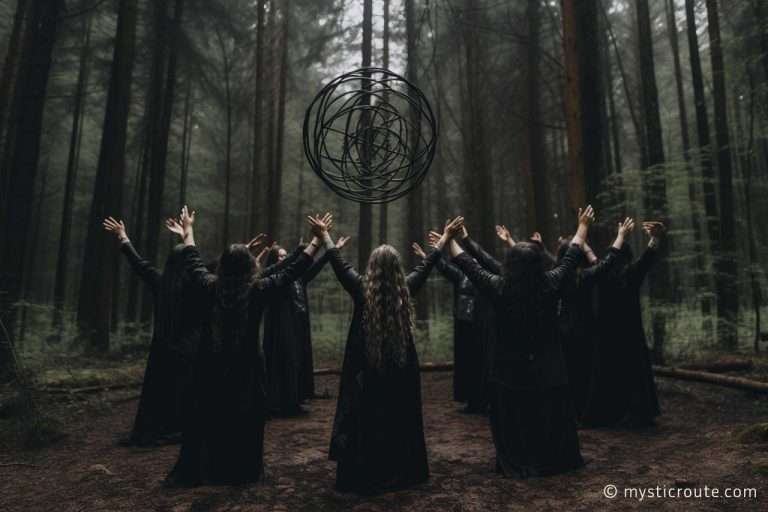
The fundamental practice of Wicca involves the creation of a sacred space known as the circle, which provides protection and facilitates the connection to divine energy. It represents the unity of all things and the eternal dance of creation and destruction. Casting a circle involves several key steps, including the purification of the space, the creation of a protective barrier, and the invocation of elemental powers and deities.
The Divine Dance: Invoking Deities and Guides
Wiccans believe in the divine’s duality, represented by the God and the Goddess. In addition, they join forces with other divine beings and guides from multiple traditions. Rituals require visualization, prayer, and offerings to establish a connection and seek the wisdom and power of the entities that are invoked.
The Art of Magick: Spellwork and Manifestation
The practice of Wiccan spellwork involves employing symbols, words, gestures, and tools to channel energy and bring about desired results. Spells cover areas like healing, protection, love, and personal growth. Wiccans believe in the Law of Threefold Return, understanding that energy sent out returns in blessings or challenges.
The Art of Divination: Seeking Hidden Knowledge
Wiccans use tools like Tarot cards, runes, and pendulums to seek guidance through the practice of divination. It provides insights into personal lives, the vast cosmos, and the mysteries of the universe. It helps them align with the flow of the universe and tap into divine wisdom.
The Path Within: Meditation and Self-Reflection
Meditation and self-reflection deepen the connection between the inner self and the divine. Practitioners use meditation to explore their consciousness and the divine realms. Self-reflection helps in understanding patterns and beliefs by examining thoughts, emotions, and actions.
The threads of sacred space, divine connection, spellwork, divination, and self-reflection are woven together in Wicca’s rituals and practices. They form a tapestry of spiritual exploration and growth.
Tools and symbols of Wicca
Wiccan rituals are enhanced through the use of magical tools and symbols that connect practitioners with the divine. The artifacts are inspired by ancient cultures and nature, representing the strong legacy of Wiccan heritage. Let’s explore the significance of common tools and symbols, such as the athame, wand, chalice, pentacle, and the elements.
The Athame: A Powerful Ritual Dagger
The athame is a ritual knife that represents the practitioner’s will and serves as a tool for energy. It is primarily used to direct and focus energy, as well as to mark sacred space. The athame symbolizes discernment and cutting through illusions.
The Wand: Channeling Divine Energy
Wands symbolize the practitioner’s connection to the divine and their ability to channel spiritual energy. They are traditionally made of wood and can be adorned with materials that resonate with the practitioner’s intentions. Wands are used to invoke deities, guide, and direct energy during spellwork.
The Chalice: Symbol of Life and Nurturing
The chalice represents the feminine principle and the element of water. It is used to hold water or wine, symbolizing the blessings of the deities during rituals. During the Great Rite of Wiccan Ritual, the chalice embodies the feminine and symbolizes the union of God and Goddess, while the athame, or wand, represents the masculine. The union of opposites creates energy that facilitates manifestation.
The Pentacle: Symbolizing Earth and Spirit
The pentacle, a symbolic representation comprising a five-pointed star encircled by a circle, signifies the interconnectedness of these elements. Each element is represented by a point, and the fifth point symbolizes the spirit. The pentacle serves as a tool for energy focus and object or talisman consecration.
The Four Fundamental Elements:Air, Earth, Fire, and Water
The foundation of Wiccan practice rests on the four principal elements of earth, air, fire, and water. These elements are the very cornerstone of existence, responsible for every single phase of the universe. Each element corresponds to a cardinal direction and a season and has symbolic associations:
- Earth represents stability, grounding, and manifestation.
- Air represents intellect, communication, and movement.
- Fire represents passion, transformation, and will.
- Water represents emotion, intuition, and healing.
The elements are honored and invoked in rituals through the use of elemental tools, altar placement, incense, candles, water, salt, or stones. The tools and symbols in Wicca act as an expansion of the practitioner’s energy, enhancing their relationship with the natural world and elemental forces. Wiccans use these magical artifacts to connect with the earth and the cosmos, showing respect for the interconnectedness of all life.
Conclusion
Wicca is a modern pagan religion that merges ancient wisdom, reverence for nature, self-discovery, and magical practices to offer a profound spiritual path. Our exploration of Wicca’s beginnings, doctrines, ceremonies, and signs has given us a more profound insight into its spellbinding magnificence and life-altering potency.
Wicca has its roots dating back to the mid-20th century, when Gerald Gardner spearheaded a revival movement that brought about its resurgence. Drawing inspiration from pre-Christian pagan influences, ceremonial magic, and the occult, Wicca has since become a widely practiced religion. Wicca has since grown to address contemporary needs and concerns, with new traditions emerging and Wiccans becoming advocates for environmental stewardship and social justice.
Wiccan beliefs revolve around an intense respect for nature as a living entity filled with spiritual energy. Wiccans worship a Goddess and a God, representing the divine forces in the universe, and strive to uphold the Wiccan Rede, promoting personal growth and respect for others and the environment. The Rule of Three underscores the interconnectedness of all actions, emphasizing the importance of mindful choices.
The Wheel of the Year, comprising eight Sabbats, forms the sacred cycle that connects Wiccans to the rhythms of nature and the cosmos. Each Sabbat represents a unique energy and symbolism, reflecting the eternal dance of life, death, and rebirth. Wiccans align themselves with the cycles of nature and gain insight into their spiritual journey by celebrating these seasonal festivals.
Wicca encompasses rituals and practices such as casting sacred space, invoking deities and guides, spellwork and manifestation, divination, and self-reflection. These woven threads of Wiccan craft create a tapestry of spiritual exploration and growth, deepening the connection with the divine and fostering personal transformation.
Magical tools and symbols play a significant role in Wiccan rituals, enhancing the practitioner’s connection with the divine and the natural world. The athame, wand, chalice, pentacle, and the elements represent the practitioner’s will, their ability to channel energy, the nurturing and life-giving aspects of the divine, and the fundamental forces that shape existence. Wiccans connect with the interdependence of all life and the cycles of the earth and universe through these tools and symbols.
Wicca presents a contemporary pagan faith that welcomes ancient teachings, reveres nature, and delivers a spiritual journey that can bring about significant change. It invites individuals to reconnect with the natural world, honor the divine forces, and explore their inner realms. Wicca offers practitioners a path to spiritual growth, profound insights, and a deeper sense of purpose through the adoption of its principles, rituals, and symbols.