

Table of Contents
A look into the mystical experience of Astral Travels
Dreams where we fly is a classical one. Also those where we wander around a familiar place, floating or simply walking by. This is the kind of experience that is not just a dream but actually an astral separation. Astral projection is not as rare as we might think! Every night, it happens.
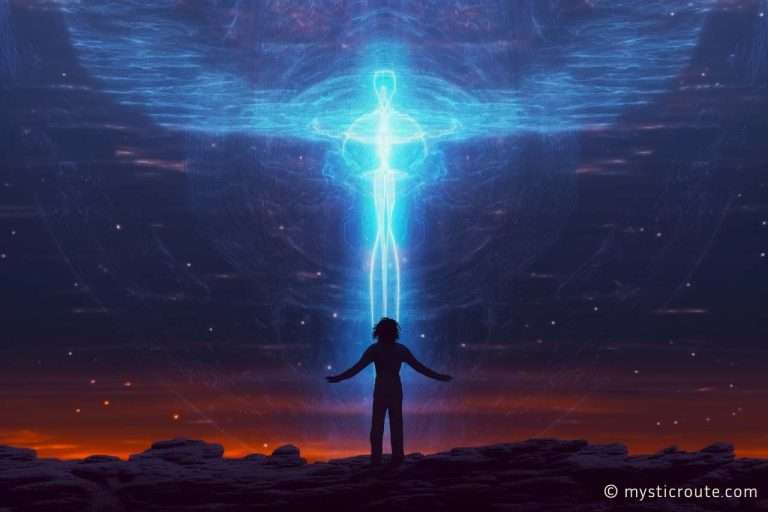
Astral projection, a.k.a. astral travel, has captivated spiritual seekers across cultures. As an ancient esoteric practice, the separation of the astral body from the physical one has been reserved for those who would be in contact with higher deities, since consciousness would go beyond the limits of the physical realm and explore the astral plane a subtle dimension said to exist parallel to our own.
Let’s take a dive into the intricacies of astral travel, its history, key concepts, techniques, and manifestations across spiritual traditions. Giving a quick glance to its philosophical and scientific implications, to reflect on what can be revealed about the nature of consciousness, reality, and our human desire to seek transcendence.
The timeless tradition: a brief history of Astral Travels
Our human concern about the idea of something soul-like has existed since the creation of Gods, inspired by natural forces. Observing that natural phenomena had a “personality” of their own led ancient cultures to believe they were alive like them. They were treated as persons, but without a body they lived in, cultures ended up seeing them as spirits. Those questions opened the doors to inquire about our own spirits, and since then, the astral realm has begun to be explored.
The belief in an astral body and a separate astral realm of existence is an ancient one, spanning many cultures, religions, and belief systems. Most of them had a deep concern about the afterlife but also frequent contact with their ancestors, who were always treated as if they were still there in the present. Some other cultures set the spiritual dimension in a future time where they couldn’t be contacted directly but messages could still leak through.
In Egyptian mythology, the soul, or Ba, was thought to be able to leave the body and journey to the land of the gods and the deceased. The Upanishads and the Bhagavad Gita, which are Hindu texts, describe spiritual practitioners achieving the ability to project their consciousness beyond the physical form. In many Native American cultures, the spirits are the ones who give the new-born their name, not them being human until then, as if an astral being was there awaiting the name to enter the body.
In Western traditions, astral traveling dates back to Plato, who believed in a non-physical realm of existence, as well as the influential occultist Aleister Crowley, who referred to the astral body as the “body of light.” Astral projection has been the domain of shamans, mystics, and spiritual practitioners across the ages, expressing the universal human intuition of a reality beyond the physical senses.
While astral travel remains an enigmatic phenomenon, these rich accounts of transcendent experiences continue to captivate the spiritual imagination, reminding us of the depth and grandeur of human consciousness. And how does astral projection work? Where could it lead us? Do we need a “gift” to achieve it?
The astral body and the silver cord: key concepts in Astral Projections
As mentioned before, astral projection is not something rare since we mostly achieve it when we sleep, unintentionally. You can purposely train yourself to navigate this realm and experience it with courage. Also, astral projection can be achieved through practice in a safe space during particular moments where you know nothing will disturb this process.
Astral travel rests on the idea that human beings possess an immaterial double—the astral body—linked to the physical body by a silver cord. Just as a baby in a pregnant body is linked by an umbilical cord, our astral being is attached to our physical body by a silver cord. Astral bodies might have the ability to move outside the physical form, journeying through the astral plane.
If you ever felt that a room was vibrating or buzzing in a weird way, or that you felt rejected by it when you entered, that’s probably because you are a sensitive person and can notice when a place is crowded by some “guests”. The astral plane works in the same way, where it exists in parallel to our own material world but at a different vibration.
The astral plane is a dimension that is not ruled by our natural physics but by holographic parameters like ubiquity and immateriality. Since the mind in the astral body isn’t bounded by our physical and cognitive limitations, in there our thoughts and emotions manifest instantly, time and space are malleable, and heavenly or infernal scenes may unfold, as they are dimensions that one can visit if experienced enough.
The astral plane is thought to contain multiple layers as dimensions that coexist, from the lower realms of dream and desire to the highest celestial spheres, with all kinds of beings as their inhabitants or passersby. Also, doors to the astral plane can be opened from our physical realm in a ritual context without doing astral projection. It would be as if multiple rooms existed in one place simultaneously, and we could go up or down a ladder energetically.
While controversial, astral projection is said by some to offer insights into unexplored realms of existence and untapped regions of human potential. During astral travel, the astral body is thought to explore this plane, encountering spiritual beings, departed loved ones, or even fantastical dreamscapes. The silver cord, an ethereal connection between the astral and physical bodies, guides the traveler back to the material form. This is why it never breaks its tie with its physical body, since it could lead it astray and probably never return. However, unless physical death occurs, breaking that tie is not something that happens since it’s not a physical rope; its force is tied to the body’s own energy. So, after all, astral projection is a safe practice if done correctly. Let’s follow to see some techniques to try.
Inducing Astral Travels: techniques and practices
As mentioned before, our astral body projects itself when we sleep. Our brain’s neural activity is measured by different waves that turn our mind into different states, from Delta (deep sleep and no dreaming) to Theta (REM, meditative, or hypnosis), then Alpha (when awake, chilling or distracted, prior to sleeping), to Beta (lucid state, intense activity, like work or study, focusing the mind), and ending in Gamma (hyper stress, anxiety, adrenaline, or panic). These are the ranges where our neurotransmitters work: from busy (Gamma) to still (Delta).
Astral projection is said to occur in a state of deep relaxation or meditation, in the Theta state, on the threshold between wakefulness and sleep. Many practitioners use visualization, meditation, or trancework to induce an out-of-body experience intentionally, while for others, astral travel occurs spontaneously, often during sleep or highly emotional states.
There are also some specific astrological moments that could make this experience more accessible, for example, when the moon is in Pisces or Aquarius or there are stelliums (an accumulation of planets) in those signs or personal planets aspecting Neptune or Uranus, both in the sky or in your own chart.
These are good steps to achieve astral projection. What is best to begin with is creating a space of meditation that is a familiar place for you, ensuring no one will interrupt you or disturb your ambient. It’s important to be well rested so you don’t fall asleep while you practice the projection. You may tune up some frequencies of Theta waves and use scents for relaxing and releasing your mind from daily issues. Lay horizontally and comfortably, visualizing an orb of light above your head. Three common astral projection techniques include:
1. The Rope Technique: The practitioner visualizes grasping an ethereal rope with the astral hands and pulling themselves up and out of the physical body.
2. The Roll-Out Technique: The person imagines rolling out of their body as if turning over in bed, entering into the astral state.
3. The Target Technique: The traveler focuses their mind on a distant location or object, imagining their astral body journeying to and exploring it.
During astral projection, sensations may include feelings of floating, flying, spinning, or vibration. It is said that remaining calm is key; anxiety or fear can hinder the experience or cause an abrupt return to the physical body. Nothing will take you further than your own curiosity. To come back, simply follow the silver cord, or if you aren’t deeply immersed, simply open your eyes. While controversial, practitioners report that the astral plane contains wonders as well as challenges, and confronting fear or desire is part of the journey.
Astral Travels in spiritual traditions across cultures
The belief in a parallel astral realm and the ability to transcend physical limits appears in many spiritual and esoteric traditions. A few examples include:
• Ancient Egypt: The Egyptians believed the soul could leave the sleeping body, journeying to celestial realms. The “Ba” and “Ka” were aspects of consciousness that could explore the astral plane. The earliest evidence to this day of astral projection is found among this culture’s sacred scripts.
• Indigenous Spirituality/Shamanism: The belief in an astral realm and the ability to journey beyond the body appear in many indigenous traditions, from Hawaiian Huna to Native American shamanism. These practices often involve connecting with spiritual guides and ancestors and traveling to spiritual realms for guidance, healing, or divination. The shaman accesses these realms through drumming, dance, or the ingestion of sacred plants. It’s in the astral plane where shamans interact with other spirits that are as important as humans and are often considered humans as well, even though they are animal-shaped in the physical realm.
• Hinduism: Ancient Hindu texts like the Upanishads describe advanced spiritual practitioners gaining the power to project consciousness into parallel spiritual dimensions and experiencing higher realities. Practicing yoga helps a lot to access the state of mind necessary to reach astral projection. In some traditions, astral projection is considered a supernatural power that yogis can achieve through meditation, breathing exercises (pranayama), mantra chanting, and asana. A modern practice of it is called “Dream Yoga”, where astral projection is promoted through lucid dreaming.
• Theosophy: The Theosophical tradition, popularized in the late 19th century, incorporates beliefs from Eastern and Western esoteric spirituality, including the existence of subtle astral bodies and parallel astral planes of reality.
•Contemporary Spirituality: Today, many spiritual communities and books explore astral projection, from new age channeling and ascension practices to the writings of mystics like Jane Roberts and Emanuel Swedenborg.
This diversity of cultural and spiritual manifestations suggests that belief in a non-physical plane of existence and some form of transcendence of bodily limits is a ubiquitous human intuition. Astral projection and mysticism seem to offer a glimpse into humanity’s timeless longing for the infinite.
The mind-body problem and the Astral Enigma: philosophical and scientific perspectives
In our actual times, the phenomenon of astral travel keeps raising profound philosophical questions about the nature of consciousness and its relationship to the physical form. Can consciousness exist independently of the brain and body? Does astral travel offer evidence for a non-physical realm of existence, or can such transcendent experiences be explained scientifically?
As it happens with any extraordinary experience, mainstream science remains skeptical about astral projection, viewing consciousness as inextricably linked to brain function. Several theories attempt to explain out-of-body experiences:
•Altered states: Astral projection could be just an altered state of consciousness, such as the hypnagogic state between waking and sleep, causing illusionism. The mind is highly suggestible in these states, and vivid experiences may seem realistic. However, where is the line for what is “real” in this?
• Expectation and belief: The mind’s expectations and beliefs can strongly influence perception and experiences, especially in altered states of consciousness. Perhaps astral experiences reveal the power of belief rather than a separate astral reality.
• Self-perception distortion: Out-of-body experiences are linked to temporary disruptions in the brain’s construction of self-perception and body image. However, this remains speculative and does not prove that consciousness is wholly reducible to physical processes.
• A glimpse of spiritual realms: For practitioners of esoteric spirituality, astral travel offers evidence of higher spiritual dimensions and consciousness beyond the physical senses. Our limited scientific understanding cannot rule out such transcendent possibilities.
Since our science is mostly dedicated to the material and observable world and has developed its inventions towards that, the mysteries of the spirit and the mind still remain untouched by science. Can we think that something doesn’t exist just because technology that measures those activities hasn’t been invented yet? How many other hypotethical manifestations are used in physics theories that, although not proven, are still validated by science?
While the debate continues, astral projection remains a controversial yet timeless phenomenon, one that invites us to ponder the deepest mysteries of human consciousness and reality itself. Both science and mysticism seek to unveil the nature of the mind and its boundaries. But astral travel offers a glimpse into realms of experience that remind us how much remains unknown, unexplored, and profound within and beyond the human spirit.